


Teaching Tips & Tricks, Uncategorized | Jan 14, 2013
Math partner games for the Common Core

By Angela Watson
Founder and Writer
Math partner games for the Common Core
By Angela Watson
When I first started delving into the Common Core State Standards (CCSS) for math, I thought to myself, How different can these expectations be? Math for elementary schoolers is math for elementary schoolers, right? It wasn’t until more careful examination of the standards (I refuse to use the term ‘unpacked’) that I realized how much more rigorous they really are. I love the new focus on depth over breadth, which is something I think all teachers have wanted for many, many years. What I don’t love is how often teachers are expected to teach in an entirely different–and far more challenging–way with the same materials they used with the old standards.
So I’ve been thinking for awhile about what kind of teaching resources I could create to support teachers in implementing the standards. One of my favorite strategies for math instruction is a partner game routine, which you can read all about on the Math Partner Games page on my site. Essentially, the games work like this: for about ten minutes per day, students pair up and explore math concepts through hands-on math practice. I try to select games that allow kids to actively construct knowledge and have problem solving discussions with their partners.
Math games can be also used as centers or work stations, but I like the daily partner game routines because a) You can conduct mini-lessons and strategy discussions around shared experiences before and after game play, b) You can focus on facilitating critical thinking and observing students’ problem solving attempts during game play (since you’re not teaching a small group like you would be during centers), and c) Students play the same game for a week, so you have lots of targeted opportunities for reinforcing higher-level thinking skills, identifying and addressing misconceptions, and scaffolding student learning.
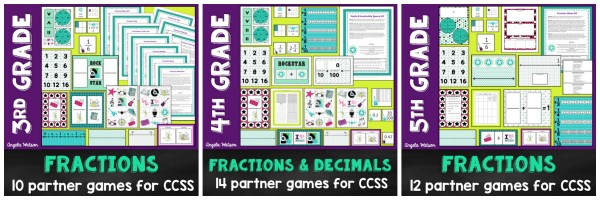
I thought math partner games would be the perfect way for kids to practice the “new” math skills of the CCSS, so my project for the next few months is to create a set of games for grades 1-5 that are specifically designed to meet the standards for all the domains. I started with the Number and Operations–Fractions domain, and am really excited about how it’s turned out. The CCSS includes a lot of approaches to content that many teachers haven’t used extensively (like teaching fractions on a number line, or interpreting multiplication as scaling/resizing). I’m really enjoying the challenge of analyzing these skills to determine how they can be turned into fun learning games for kids.
Most of the games I’ve created are completely different from grade level to grade level, but I’ve kept some of the same game titles and concepts and adjusted the level of difficulty and rigor. Here’s an example of the Fraction Show Off game and how it would be played in grades 3, 4, and 5:

The games are $1 (or less) each and are sold as a bundle for the domain so you get everything you need to teach all the standards, including multiple games for the major standards so students can explore the concepts in different ways. Another benefit to having so many games is that you can play some during math partner game routines, use some as small group lessons or whole class lesson activities, place some in your math centers, and even send some home for students to play with their families. The game cards and resources can double as student manipulatives during math lessons.
Here are some of the unique features of the games:
- Integration of higher-level thinking and critical thinking skills (not just rote practice)
- Hands-on activities through which kids actively construct knowledge: no worksheets!
- Options for open-ended game play so that students are not “finished” until time is up
- Challenge activities to extend game play and/or differentiate it
- “Math Talk” questions/prompts to encourage students to analyze strategies and reflect orally or in writing about what they’re learning
And this is what you get in the download:
* 20 pages of info and forms that contain everything you need to get started with math partner games. There are blank partner game lists, tips (with photos!) for how to create/ store/ organize/ distribute/ collect the games, and lots of ideas for how the games can be used for skill-based mini lessons and math journal reflections.
* 10-14 pages of game instructions (depending on the grade level): there’s one page for each game, featuring the materials needed, directions for game play, a Challenge activity, Math Talk questions/prompts, the CCSS alignment, and student-friendly “I Can” statements.
* 30 (or more) pages of rockstar/music-themed game boards and mats, game cards, spinners, and other colorful and fun materials for game play. Most of the materials are open-ended and can be used in lots of different ways so you have fewer items to print and create. The only additional items you need to provide are page protector sheets, Vis-à-vis or dry erase markers, paperclips to make spinners, and some sort of fraction manipulatives (like fraction bars or strips).
You can download a sample of the related game materials by clicking on the image below:

If you you want to get notified on the same day that a new set of games or materials is added, just click “Follow” at the top of my TeachersPayTeachers store and you’ll receive an email whenever I add new stuff.
Thanks for your support! I hope you find these games helpful, and at a dollar per game (or less!), I hope they’re affordable, too. Enjoy!
Angela Watson
Founder and Writer
Discussion
Leave a Reply
OR

Join our
community
of educators
If you are a teacher who is interested in contributing to the Truth for Teachers website, please click here for more information.


Thank you so much for putting together this fraction stuff! Our fourth grade teachers are screaming that our kiddos don’t know enough about fractions when we send them on to fourth grade. So, we are taking about 30 minutes each Friday for our “Fun Fraction Fridays” to try and get more in, even though we’re not even there yet in the curriculum. These games will help immensely! I am getting tired of searching for ideas!!
Hi Angela:)
I team taught third grade with you at Sawgrass. I can’t believe I opened this page and saw your face! How funny. I hope all is well with you. I will be checking out your site for some great ideas.
KIIIIIM! We need to connect again–I’m so glad you stumbled on the site! I still think of all the things I learned from you (as a matter of fact, I just wrote about one here: https://truthforteachers.com/2013/05/how-to-get-students-to-follow-directions.html!) What a crazy but amazing year that was. I’m doing very well, yes! I feel so blessed to be doing the work I’m doing. Congrats on your second little one (Diane shared the happy news with me awhile back)!
I found your page about paired math games, which look wonderful. The feed says you can click on the picture to read directions, however, that does not work. Where can I find instructions for the games?