


Uncategorized | Apr 18, 2012
The World’s Easiest Token System for Behavior Management

By Angela Watson
Founder and Writer
The World’s Easiest Token System for Behavior Management
By Angela Watson
The token system was the first behavior management plan I designed for primary grade students, and the popularity of this system continues to astound me! I posted it on my website many years ago and had no idea just how well it would resonate with other educators. There are literally hundreds of teachers around the world who have used this plan, which I named ‘The World’s Easiest Token System’ after researching complicated token economies that had me exhausted by the time I got through reading about them.
The system described here is excerpted from The Cornerstone book. It was featured in Education World and was listed as a resource on the National Education Association’s website shortly thereafter. While I love creating new plans and have since experimented with numerous other behavior management systems over the years, the World’s Easiest Token System will always be special to me because of its powerful resonance with other teachers and its positive impact on so many classrooms.
Why this token system works
The token system is effective because it DOES NOT require:
- you to track each child’s behavior in order to penalize or reward
- the entire class to ‘behave’ in order to be rewarded
- you to punish those who did behave due to actions of those who didn’t
- the same behavioral standards for everyone
- students who are frequently in trouble to get all of the reinforcement
- any money to be spent on candy or prizes
- the staging of elaborate rewards
- a complicated class helper system (tokens assign many job privileges)
- class time that should be spent on academics
- a lot of maturity in students: even preschoolers can participate
Setting up the token system
Find some chips, tokens, cubes, or whatever items you can access—even small laminated slips of paper will work. 10-20 per child should be enough. (If you want tokens exactly like the ones I used, check out the two color counter math manipulatives on Amazon.)
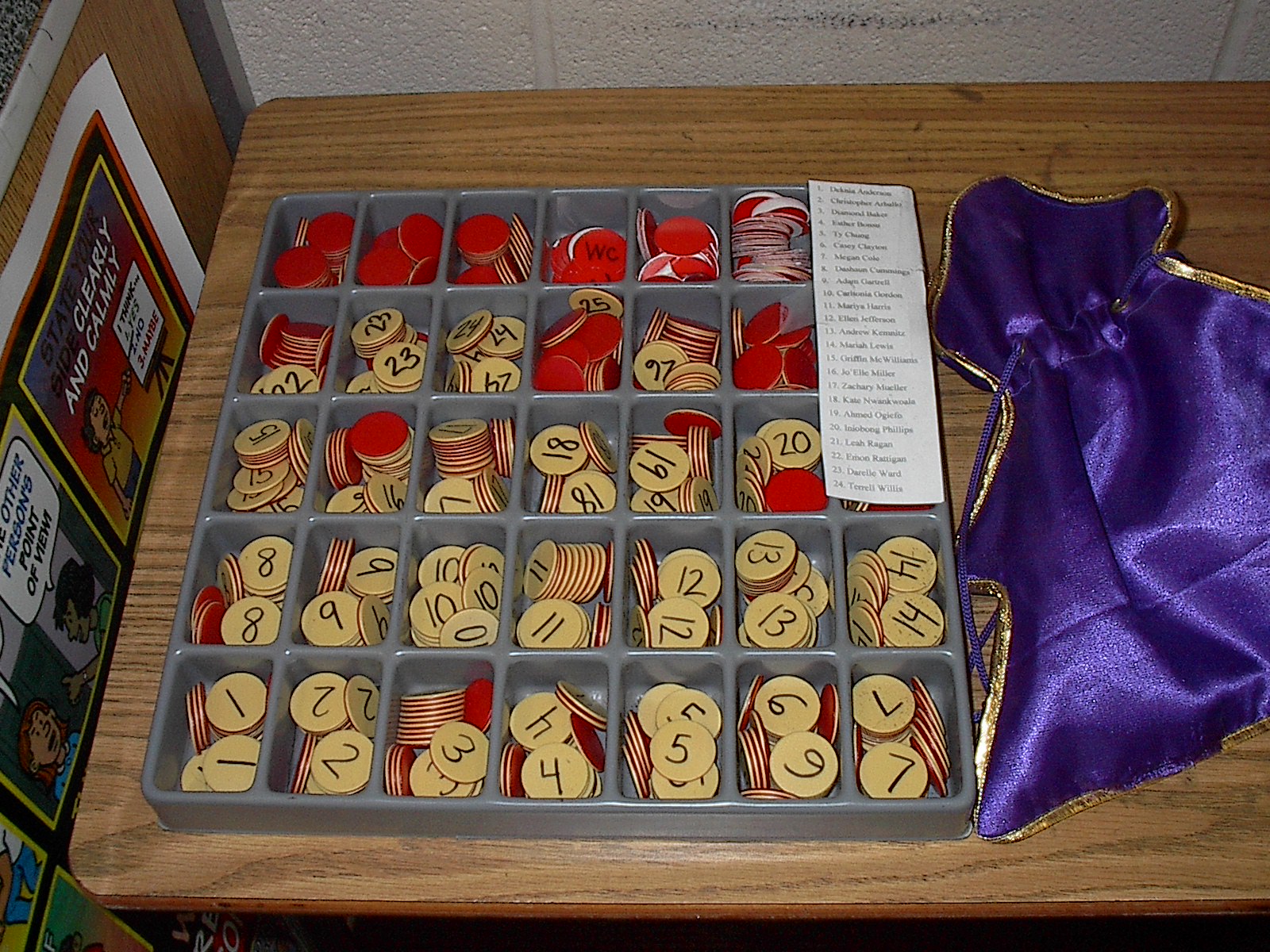
Assign personal identification numbers (PINs), and write them on your tokens. If your students don’t have numbers for another purpose, assign them for this. (You could write children’s names on the tokens, but then you will have to make a new set each school year and whenever new kids transfer to your class.) Keep each group of tokens sorted into separate sections in some kind of container, like a tackle box or craft supply organizer. (Mine was given to me from a retiring teacher, who got it from her construction-worker husband). Last, find or make a box or bag to put the tokens in when they are awarded. I use a sparkly purple and gold drawstring bag I found from a dollar store a few years ago. You only need one for the whole class.
Introducing the system to students
Explain to your class that each teacher has a method for rewarding good behavior in students. Ask them to recall some of the ways other teachers have rewarded them, e.g., stickers, play money for a class store, or a paperclip chain to earn a pizza party. Be prepared to limit the discussion, as rewards will be a very popular topic!
Discuss with the kids how they might have earned those rewards in previous classes. Encourage specific responses. This is also a good way to set behavioral expectations for the year, and check prior knowledge. You may want to list their ideas, or write down just the ones that you will be reinforcing. Decide ahead of time whether you will also reward academics with the token system or if it will be purely social/behavioral.
Tell children that this year, in their new class, tokens will be awarded to the children who exhibit the behaviors you discussed and other appropriate actions. Stress that tokens will not be awarded every single time, but that you will surprise students and they never know when they will have a token added to the bag. This is an important point so that they do not wait to be rewarded each time they follow directions. You might also want to mention that if a child asks for a token, he will not be given one, no matter how good of a job he did. You are the only person who determines when tokens will be awarded.
Make a big production out of showing the token organizer and your special container, then demonstrate how you will award tokens. Tell a child that you liked the way she came in that morning and started working right away, so you will take a token with her number on it and put it in the bag. Tell another child you noticed he walked quietly in the hallway, and make a big show of putting in a token for him. Give specific reinforcement to each child in the class and add tokens to the bag. Tell the students that they will have opportunities to earn tokens every school day, all day long.
Demonstrate how you will pull tokens and give rewards. Emphasize that tokens will be pulled whenever you have a special job in the classroom, and how you might pull a token at any time throughout the day. If you will also pull tokens at a set time or on a specific day, explain that as well.
Begin using tokens for classroom privileges right away. If you go to music class right after the discussion, you could pull a token to determine who will line up first, or who will carry the chorus permission slips. Use the tokens frequently during the first few weeks of school so children can learn how the system works and make connections between their behavior and privileges. Keep your token economy rewards simple and use them frequently!
How to use and maintain your token system
Put tokens in the bag whenever you see behaviors you would like to encourage. Pull tokens from the bag whenever you need to select a student for a privilege or special responsibility. Using tokens prevents you from having to recall who has ‘behaved’ recently and determine whether you are calling on students equitably. Since appropriate behavior is what causes tokens to be added to the bag, the higher the incidence of good behavior, the more likely a student will be to receive extra responsibilities and privileges.
Using tokens will simplify your helper system—you don’t have to assign every conceivable job to a student, because you can pull tokens for occasional tasks. Use tokens when you need a student to:
- pass out art supplies
- take a message to another teacher’s room
- work a problem on the board or overhead
- participate in a role play
- hold a book, poster, chart, or other prop while you teach
- call the other students to line up
- run irregular errands
- choose a read-aloud
- complete small tasks for other teachers
- monitor behavior when you are briefly out of the room
- help the Star of the Week
- bring you something from another part of the room/school
- carry things in the hall
- sit in a special seat
- read from texts to the class
- share journal entries
- serve as group leader for activities
You can pull a set of number of tokens on a certain day or time, such as every Friday at dismissal, to distribute additional rewards. If you give your students prizes, this would be a good way to do it, but this system does not require any tangible rewards or expense on your part.

Be sure that after you pull a token from the bag, you put it back into your organizer, rather than back in the bag. Empty out the bag every week, month, or quarter, depending on how many tokens you have and how often you want your class to have a fresh start. Students should be able to sort the tokens by number back into the organizer for you during indoor recess or dismissal.
Angela Watson
Founder and Writer
Discussion
Leave a Reply
OR

Join our
community
of educators
If you are a teacher who is interested in contributing to the Truth for Teachers website, please click here for more information.


I have been looking for a fresh new way to award and encourage behavior!!! I am thrilled to try this in August! Thanks for sharing!!!
There is a lot I like about this system. One tweak I would suggest is to also reward students for using self-regulation and calming strategies. You’re going to have students who earn fewer because they do not have the tools/skills/abilities regulate themselves. I would allow students to either earn a token for doing the right thing at the right time or using a strategy to manage themselves. There is also a nice data component here – you can count the tokens at the end of the day and hopefully, if you are teaching the necessary skills to low-skilled students – you will start see their tokens flip from “strategy” tokens to positive behavior tokens.
How would a token economy work in a high school?
I wouldn’t recommend it for high school. I think it’s too much to keep up with for multiple classes, for one thing.
Would it be too late to start this now in the middle of the year? I think it is a good idea. I have two students with very challenging behaviors, though, and I am afraid they will not get very many tokens…
Virginia
Definitely not too late! It’s good to switch things up mid-year and keep things fresh. Also, you can ensure these 2 students get tokens by focusing on smaller efforts to make good choices, or non-behavioral issues.
Sorry but I didn’t understand , after earning tokens , what will they do with them ? , I mean should they get a prize after collecting a certain number for example ??
No, no prizes. The kids don’t collect tokens. The tokens go in the bag when they earn them. You pull a token out the bag randomly when you need a helper with something, etc.
Hi, I still don’t understand. What is the children’s incentive for good behaviors if the tokens don’t signify any reward? How is being a teacher’s helper in itself rewarding? Isn’t that only rewarding for extroverted students who like that sort of thing?
Almost all kids like getting to be chosen to do something special that no one else is doing. Plus, it’s fun to be “picked.” I also think the relationship with the teacher factors in (if you like your teacher, it’s even more special to get to do something to help.)