


Uncategorized | Oct 10, 2011
Tips for Parent-Teacher Communication

By Angela Watson
Founder and Writer
Tips for Parent-Teacher Communication
By Angela Watson
Looking for easy ways to increase parent-teacher communication and keep parents informed about behavior and academics? This page will direct you to resources for updating all of your parents or just the ones whose children need extra accountability.
Document parent communication
It’s very helpful to document and keep track of interactions you have with students’ parents. This is a form I developed for that exact purpose–it’s like a parent-teacher phone log but is designed for recording all important interactions with students’ families.
The top part of the free parent-teacher communication log leaves room for contact information for whichever adults are in the child’s life (since it may not be mom and dad.) The Date/Initiated 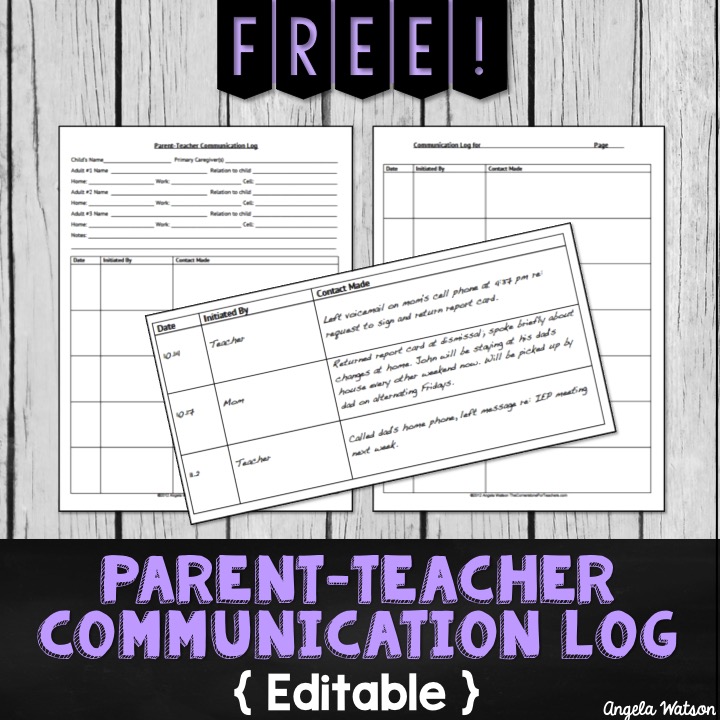 By/Contact Made chart serves as documentation of the attempts I’ve made to contact parents as well as the actual conversations. I’ve had lots of experiences where students’ home phones are disconnected, parents don’t answer the phone or return messages, etc., so this format allows me to document my efforts toward communication even when I’m not successful.
This log was invaluable when I was subpoenaed for custody cases, explaining to RTI committees why parents had not yet signed paper work, etc. The log is also really useful if you have highly involved parents, as it will help you keep track of their requests and questions.
Send home parent surveys
I like to send home four types of parent surveys during the school year. The first is a Parent Volunteer Survey to communicate ways parents can help out with classroom needs. The second is a survey after the first progress or interim report of the school year and again mid-year to help prevent conflicts and confusion at report card time. The third parent survey is for after report cards are sent home to learn more about the kids’ and parents’ attitudes toward you and school, confirm parent-teacher conference times if needed, and so on. The final survey is an end-of-year parent survey to learn more about how your teaching style was received by students and families, analyze your strengths and weaknesses as an educator, and plan for improvement in future school years. I have made an editable version of my parent surveys available on TeachersPayTeachers.
Daily or weekly behavior evaluations
Sending home daily or weekly evaluations to keep parents updated on behavior and work habits is generally not a requirement for teachers but certainly worth considering. They’re a quick, easy way to:
- have a highly structured yet simple system for recording progress
- notify parents when class work/homework isn’t being turned in
- hold children accountable for their choices
- provide positive reinforcement and/or consequences for work habits and social skills
- keep documentation that you’ve notified parents about issues
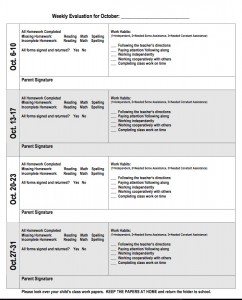
Check out the Daily/Weekly Behavior Reports page (which is part of the Behavior Management section of this website) for detailed information on how to create behavior reports for parents and how to manage the behavior reports. You’ll also find free printable behavior report forms, holistic assessments of social and study skills, tracking forms to record behaviors, and reports on academic progress.
Use a newsletter to communicate with parents
You can use paper or digital newsletters to keep parents updated on what’s happening in the classroom. The Create a Class Newsletter/Blog page provides lots of tips on using traditional ways of communicating with parents as well as digital tools and social media.
Tips for holding effective parent conferences
The best format for parent-teacher conferences, in my opinion, is student-led conferences. By inviting the student to the parent-teacher conference, the child takes ownership over his or her own learning and has the opportunity to demonstrate more responsibility for his or her choices. Check out the Student-Led Conferences page for details, including a free printable guiding question sheet you can use during your conferences.
Create more positive parent-teacher interactions

I love to send “Good News From School” postcards at least once to every student during the school year. Usually I fill out the entire stack with students’ addresses and then pick one each week to write a short note on and send home. It’s not too big of a hassle and the kids (and parents) LOVE it! You can download my postcard design in full color and black and white. Mine postcards are printed through an online printing service because I hate buying color printer ink and one order will last for years, but you could print them yourself using card stock.
Typically I can get my school to cover the postage cost but I think postcards are such a nice way to build relationships with students and their families that I’ll pay for the stamps myself if I have to. Another idea is to just send the postcard home with the student: it’s still a nice gesture and the families will probably display it on the fridge for months.
Invite parents into the classroom
One of the best ways to include parents in your classroom is to invite them in! I’ve held monthly family festivities for parents which I’ll share more about on this page in late April 2015.
Parents can also participate by volunteering for tasks that can be done at home. Read more about that on the Utilizing Parent Volunteers page.
Angela Watson
Founder and Writer
Discussion
Leave a Reply
OR

Join our
community
of educators
If you are a teacher who is interested in contributing to the Truth for Teachers website, please click here for more information.


LOOKING FOR DAILY/WEEKLY BEHAVIOR PROGRESS REPORT, NEED AN SAMPLE
THANK YOU
THANKS FOR YOUR HELP
Hi, Brenda! Check out the Daily/Weekly Reports page: https://truthforteachers.com/free-resources/behavior-management/dailyweekly-behavior-reports. 🙂
Communication is inevitable to keep track of your child’s progress at school. So it is mandatory for the parents to communicate with the teachers & the schools. In-spite of waiting for the parent teacher meet to happen one must look for the ways to keep track on a daily basis. As technology has made communication much easier, so one can use some messaging platform for communication. Similar way I had recently discovered an app Teno app that helps teachers to communicate with parents. It facilitates teacher and parent to communicate with each other about the child’s progress at school.