


Creating a Cozy Classroom
By Angela Watson
The purpose of decorating a classroom is to create a functional space for learning. However, there are tips and tricks for arranging your space in a way that creates a comfortable, relaxed, and attractive environment. Your classroom is where you and your students will spend 30+ hours each week–why not take the time to make it a homey place where you can enjoy spending time? This page shows you photos of how I’ve tried to accomplish this in multiple classrooms I’ve taught in. Some are large and magnificent, while others started off as tiny, dirty places. I hope to share classroom decoration ideas that will help you regardless of the quality of space you have.
My favorite ideas for decorating (B.N.F.C.)
Forget BC and AD. Classroom life for me is BNFC or ANFC: before or after the New Fire Codes. I have been in 8 classrooms in my life, and when I think back to how I have decorated them, there are ones I loved (BNFC) and those I tolerated (ANFC). Back in the good old days, teachers could use curtains, rugs, carpets, couches, lamps, hang things from the ceiling, and cover every square inch of wall with beautiful children’s work. But now, at least in Florida, all that has come to an end. For those of you still fortunate enough to be able to make your room feel like home, here are some of my BNFC touches that I miss the most.
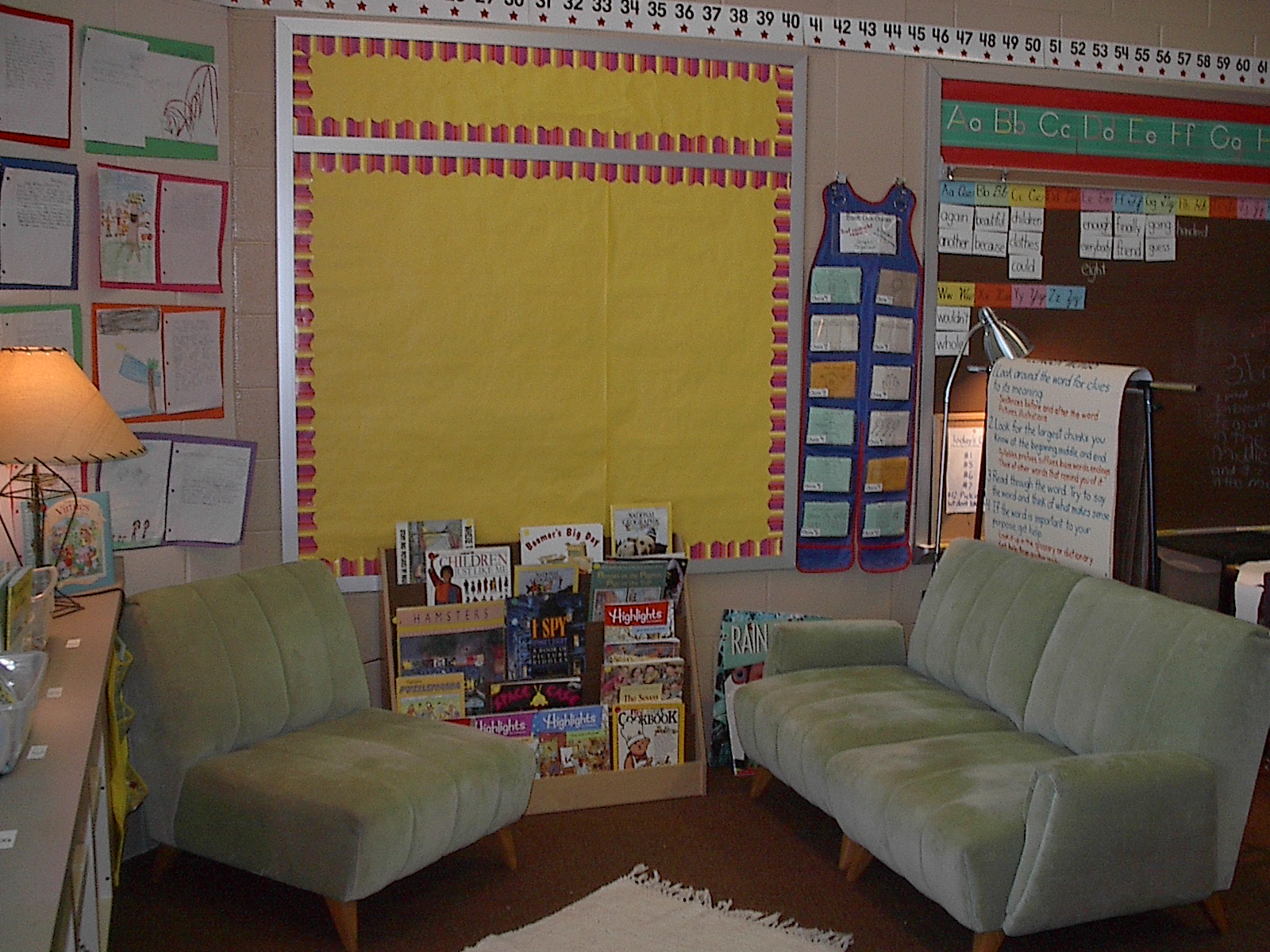
Couches and non-fire retardant rugs made a HUGE difference in how welcoming my room felt! These were 60’s mod couches I inherited from my grandmother. In one school I created a cozy reading corner with them (I held parent conferences there, too) and in the another I had it as part of my whole-group rug area. Students who listened and participated in the lessons were given the extreme honor of sitting on the couch while I taught! It was the best motivator ever. We’re allowed to use plastic chairs ANFC, and I may try that again. I do have some beach chairs in my current classroom, and while they’re not as attractive, they are an effective motivator for the kids.
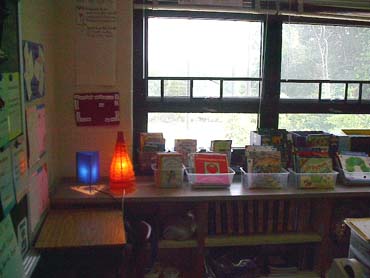
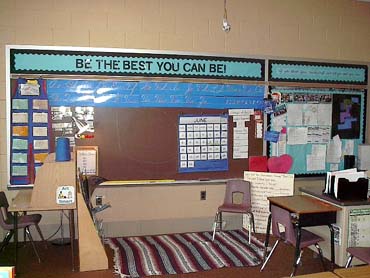
I miss my funky IKEA lamps most of all. I HATE overhead florescent lights, so I filled my classroom with nearly a dozen lamps and left the window blinds all the way up.I used a cheapbeach blanket to createan inviting area for students to gather and for me to pull small groups to. Area rugs are a cheap and easy way to make a classroom feel like a home.
You can see more of these photos (and pictures of other teacher’s cozy classrooms) on the Classroom Tour pages.
My favorite ideas for making a classroom cozy (A.N.F.C.)
Okay, enough of my pity party (the way we were…) These days we get the opportunity to be really creative…

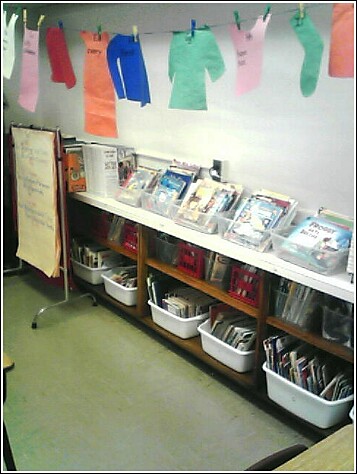
This classroom I was in had no windows and was really small, so setting up the room was a challenge. You can check out the classroom arrangement ideas post to learn the method I use for determining a classroom layout.
Also in this school, we weren’t allowed to hang anything on the walls because we had a fresh coat of paint (and this classroom had no windows, so it was starting to feel like an asylum), so I strung up yarn like a clothesline and clipped on paper cut-outs of clothes, which served as our word wall. I highly recommend this set-up even if you don’t use it as a word wall (hang posters or kids’ art- just nothing too heavy) if you are not allowed to cover much of your wall space (in Florida, no more than 80% can have paper on it). Check out the Bulletin Board Solutions page for more tips on solving wall space problems, whether you have too much or not enough.
Rocking chairs and lots of colorful bulletin board borders help. I used the borders to divide my whiteboard into sections for our daily schedule, behavior management system (team points), and teaching aides. I also had a large fake palm tree and other synthetic plants (my principal requested that I limit the number of live plants in case there are allergies). I have never experienced a problem with having live plants in my classroom, and I encourage you to use them wherever possible. They’re one of the cheapest ways to brighten up your classroom and make it feel more home-y! You can get cute little peonies and other small flowers for around a dollar, and place them on top of bookshelves, tables, etc. I had to leave my plants behind when I moved to the next school, much to the delight of my former coworkers. You can see more ideas for setting up your carpet/rug area on the Morning Meetings page.
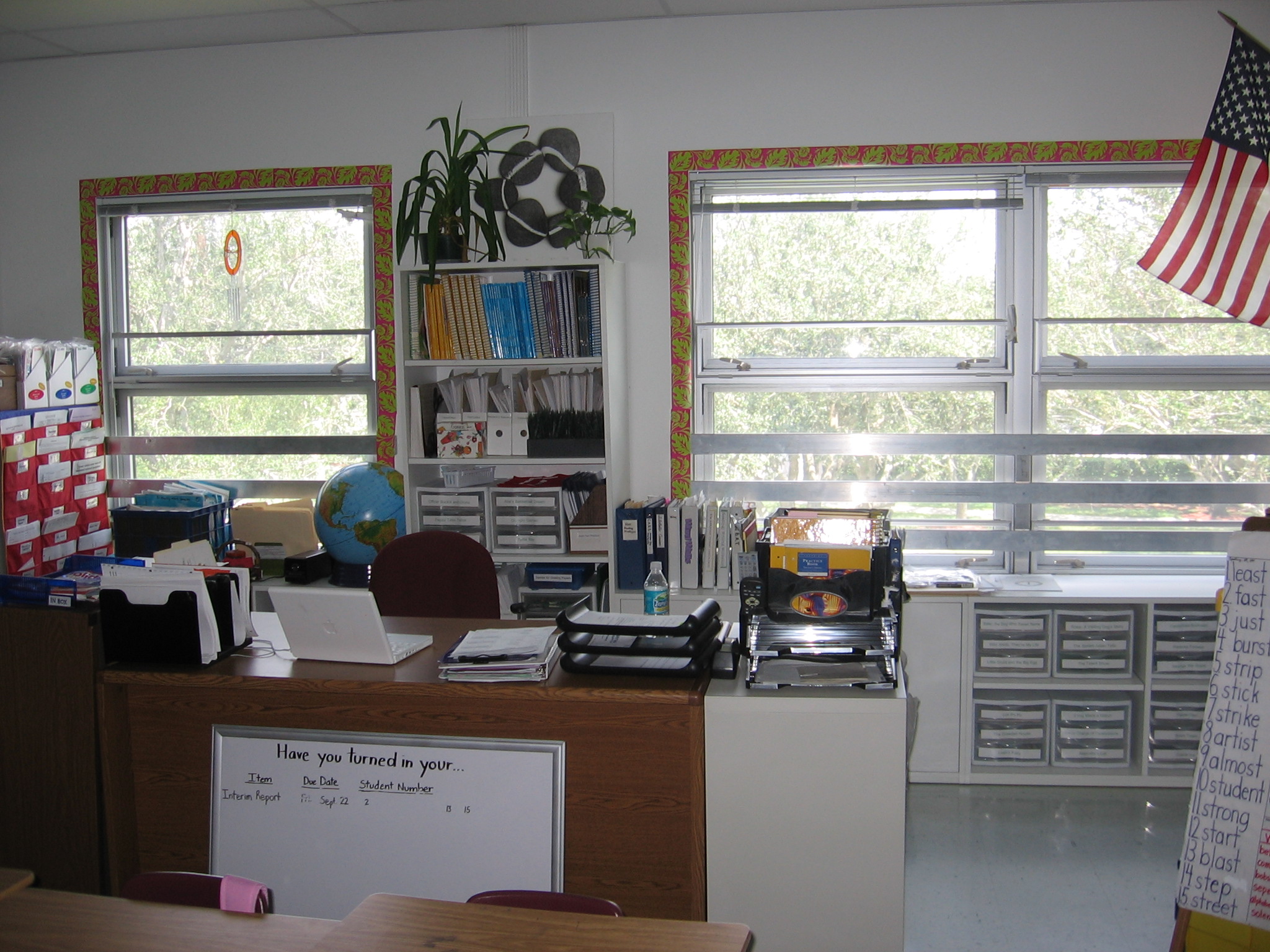
Putting bulletin board borders around the windows makes them seem larger and makes the room very inviting. I also had art and some tropical plants on top of the bookshelf, which served as a focal point when you walked into the room. This is another example of how plants can an excellent way to add some color and life to a room ANFC. I have to admit the main reason why I alwys had new plants is because I have a black thumb and everything kept dying. Perhaps not watering them had something to do with it….hmmm… A few kids took over the job of plant waterer and that helped, but I just couldn’t keep track of which plant needed which amount of water. I asked parents to send in new plants periodically throughout the year but I could only make 2 last more than a few months. Hopefully you’ll have better luck, because the plants are a great addition!
Ideas for Inexpensive Classroom Decorations
Make them.
Craft stores sell special markers that let you draw on windows. Use the die cutter (if your school has one) to cut out shapes to spruce up wall displays. Use what you have, what your school provides, and what other teachers are willing to share to make your classroom beautiful.
Have kids make them.
My kids have made posters explaining how to solve math problems, displays of different geometric shapes in the classroom, a ‘quilt’ of their favorite books, etc. Use student work rather than store-bought posters. It’s more meaningful to the kids, and tells visitors more about what’s happening in your classroom. Large paintings done by children always look beautiful, no matter how young the students.
Focus on useful displays.
A pretty poster is just taking up wall space unless it’s helping the kids learn, retain, and utilize their skills. Hang up your text connections poster, tricks for remembering multiplication facts, directions for how to do long division, a calendar with important dates and events for your students clearly marked, the correct friendly letter writing format, and so on. Refer to the posters often and your kids will, too.
Retiring teachers.
One retiring teacher I know set up a store in her room on the last teacher workday of the year. Everything was free for the taking, although donations were requested. There were tons of resource books, none of which she wanted to lug home to store in her garage!
Teacher’s Magazines.
Lots of times there are free pull-outs in teacher magazines. If your college or public library subscribes, ask if you can take the posters out.
Don’t change decorations frequently.
There’s no law that says you have to have new bulletin board displays for every holiday. Pick bulletin board paper that will work all year long and change the border, if you must. (For example, red is nice for fall leaves and apples, and then for Christmas, later for Valentine’s Day, and then for a general or thematic display towards the end of the year). I buy one versatile set of borders for each bulletin board I have and leave them up. I have frogs, planets, calendars, paintbrushes, designs, plain colors, and other themes not associated with any particular time of year. Also, remember that your border does not have to correlate with the stuff that’s on the board, as long as the colors and styles complement one another. A train bulletin board does not have to have a train border: a plain blue one will work just fine.
Display a minimum of seasonal decorations.
I try to pick borders that don’t need to be changed- I have way too much to do to worry about having snowflakes up in May! In fact, I rarely display kids’ seasonal work, focusing on thematic displays or things that look good all year, such as “Our Best Work”. When I do hang seasonal work, I try to do it at least a month before the occasion to get the maximum usage out of it.
Angela Watson
Founder and Writer
Discussion
Leave a Reply
OR

Join our
community
of educators
If you are a teacher who is interested in contributing to the Truth for Teachers website, please click here for more information.


Wow, Angela! How inspiring these classroom tours are! Thank you so much for all your hard work. Do you have plans to put any NY classroom tours on the site?
You’re welcome! I would love to add more classroom photos of the rooms I work with in NY. Most of them are in private schools so they have limited space and resources–which is definitely a common challenge for many teachers out there and I’m sure they’d benefit from seeing how things are set up. I’m also always open to posting classroom tours from site visitors–I’d love to share your room! 🙂
these are beautiful classrooms..
Muy buen trabajo con tu aula de clases, realmente pareze que tienes mucha iniciativa propia. me encanta. saludos desde Roatan, Bay Islands. Honduras
AWESOME 🙂
Hi Angela, thank you so much for those pictures that you have included in your article. I teach in a private school and the class that I in in charge of is rather ackward in size. I have already given up hope to make the class presentable or felt that it was nearly impossible when I came across your article. May God bless you for being generous in sharing your ideas.
I really love your phrase “… Teaching More Effective, Efficient, and Enjoyable”. I hope you will allow me to use the phrase in my class.
Thank you once again.
Mslaini