Avoiding the Paper Trap
What’s Here
Organizing the mounds of paper we encounter everyday is not as difficult as it seems. In fact, this page (which is excerpted from Chapter 4 of The Cornerstone book) will show you you can set up a system in a very short amount of time that will provide a place for every single piece of paper! You’ve heard the old adage: A place for everything, and everything in it’s place. It really is that simple!
7 Simple Steps to Organizing Your Papers
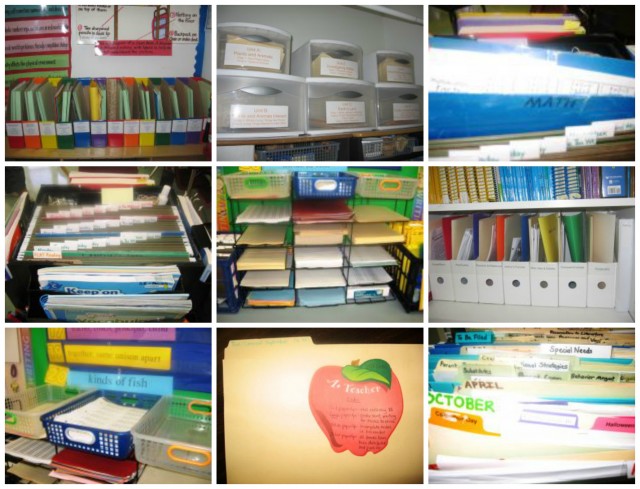
It doesn’t matter what type of containers you use, as long as you have a designated spot for each type of paper. You can use baskets, crates, magazine file boxes, metal organizers, plastic trays, or any combination of resources that are on hand. I’ll show you photos here of a variety of organizers that have worked for me over the years. I’ve changed systems many times. But the idea is always the same: there is ONE place for EVERY paper.
You MUST choose containers that make it easy to put papers where they belong. If it’s too much trouble to put them away, you won’t do it. I hear a lot of overwhelmed teachers say they don’t know where to start when it comes to tackling the massive amounts of paper in the classroom. So I divided the organizational process into steps which I’ve listed in order of priority. If you do one or two steps a week, you’ll be completely and permanently organized in about a month’s time. You can do it! These are easily sustainable systems that can be taken to any grade level and any school you teach in for the rest of your career.
Gather all the containers and organizers you have, and then choose among them for each category of papers, one step at a time. If you don’t have anything suitable, list the types of containers you’d like to buy, and then make an investment in your own sanity by heading out to a discount store to purchase them. You’ll be glad you did once everything’s in place.
Step 1) Temporary Places for Incoming Papers
Step 2) Binder for Lessons, Grades, and Reference
Step 3) Frequently-Referenced Forms and Papers
Step 4) Student Papers
Step 5) Activities and Worksheets You’re Using Now
Step 6) Teaching Resources for All Skills Taught
Step 7) General Files
STEP 1) Temporary Places for Incoming Papers
Incoming Papers From Students (Not Class Work/Homework)
To Take to the Office or Other School Locations
To Read/Do/Keep/File Ongoing Projects
STEP 2) Binder for Lessons, Grades, and Reference
STEP 3) Frequently-Referenced Forms and Papers
Emergency Cards and Other Small Pieces of Paper Papers You Need to Look at Daily
Blank Forms/Papers For Easy Reference Notes and Handouts from Meetings
Extra Copies of Papers That Were Passed Out to Students (For In-Class and to Go Home)
STEP 4) Student Papers
Artwork and Letters from Students Forms and Money You Collect from Students
Student Files (Portfolios)
Work to Be Graded Graded Work to Be Sent Home
Book Order Forms Parent Correspondence
STEP 5) Activities/Worksheets You’re Using Now
Class Sets of Photocopies and Other Materials for Current Lessons
STEP 6) Teaching Resources for All Skills Taught
Lesson Materials and Papers for All Subject Areas
(See the Lesson Materials and Files page for more details)
STEP 7) GENERAL FILES
Lesson Materials You’re Not Using Seasonal Materials
Older Files from Previous School Years
This page shows just the PHOTOS from Chapter 4 “Avoiding the Paper Trap”. The Cornerstone book and eBook includes 13 pages of detailed captions and specific instructions for creating each type of paper storage!!
Cornerstone Cross-Reference
Find even MORE info about organization and avoiding the paper trap in The Cornerstone book and eBook! Book-exclusive content includes:
Ch. 1: Classroom Arrangement
*How to create space for the 8 basic elements of an elementary classroom, no matter how small or oddly-shaped the room
*Photographs of four desk arrangements that really work (and why two others don’t)
*Attractive and useful set-ups for bulky and outdated computer stations
*The number one factor you should consider when placing your desk and workspace
Ch. 2: Planning for the First Weeks of School
*Sample lesson plans for teaching procedures during the first week of school
*The 11 things that HAVE to get done before the first day
*What to buy (and what NOT to buy) for your classroom
Ch. 4: Avoiding the Paper Trap
*Detailed instructions for establishing ONE place for EACH type of paper you come across, regardless of the space and containers you have
Ch. 5: Finding and Filing Instructional Resources
*Specific guidelines for managing your lesson materials for each subject area
Ch. 6: Organizing Classroom Materials
*How to make the most of students’ school supply lists so you don’t have to spend out of pocket
*Why you should think twice before allowing students to share materials or use communal school supplies
*Inexpensive ways to get classroom materials
Ch. 7: Maintaining a Class Library
*How to choose books that kids will want to read (and how to obtain them on the cheap)
*Quick and inexpensive ways to categorize, level, and arrange your books into baskets or bins
*How to spend just ten minutes setting up a self-running book checkout system
*Solutions for the great debate: should you allow students to take books home?
*5 simple lessons that teach your students to care for and maintain your classroom library
*Creative ways to give kids ownership over the class library
Ch. 8: Cleaning, Packing, and Moving
*What to keep, what to toss, and where to put it so you can find it!
*Step-by-step photographs that show how to pack up your old room and unpack your new one
*How to pace yourself so you don’t get overwhelmed
Classroom Forms to Help You Avoid the Paper Trap
Recommended Resources
General Classroom Organization
My Top 36 Organizational Ideas in Photographs! I’ve written a weekly column for Education World which compiles my favorite tips for organizing your classroom. Access the archive and view each week’s tip and full-color illustration.
If you think I’M organized… check out out Vanessa Levin’s PreK Pages! Her organizational tips are relevant for teachers of ALL grades. Enjoy!
Kim’s Korner has great organizational tips, and is very specific about how she runs her classroom. If you like lots of details about the day-to-day stuff (like on this site) you’ll love Kim’s site. She also provides great printable forms.
Now What?
Bulletin Board Problems Solved
Classroom Desk Arrangements
Creating a Cozy Classroom
Lesson Materials and Files
Teacher-Submitted Ideas
Latest posts by Angela Watson (see all)
- The Behavior Code (giveaway) - May 23, 2013
- 3 simple tools for backing up your computer - May 20, 2013
- How to get students to follow directions the first time - May 16, 2013
- I’m back. This is Iceland. - May 13, 2013


{ 12 comments… read them below or add one }
Love this, appreciate this, encouraged by this—THANKS.
You’re welcome, Lola!
I have been looking for this specific information for YEARS. I am known throughout my school for having the messiest desk and least organized paperwork (but I can usually find things with little effort). One year I lost my voice and one of my kids suggested, “Maybe it’s on your desk.” Just last year June, a mom and her daughter (a recent student) looked through my classroom windows. The daughter exclaimed, “I’ve never seen her desk before. I didn’t even know it was there!” I can see myself implementing many of your ideas and making them work. Thanks so much!
Oh that’s so funny about that kid saying maybe you lost your voice on your desk! LOL! I hope the paper trap info helps you make the change you’ve been wanting to create. It is totally possible to have an organized teacher’s desk–seriously, you can do this! Once you get a system in place, it will become second nature to keep things organized.
I SO had to tweet this!!!! thanks for tips i desperately needed!! GOD BLESS YOU!!
Thanks so much for the tweet, and for taking the time to comment! Very much appreciated.
I use stackable 3 drawer boxes each label with subject. Then fabric over the door shoe holders with names on the pockets for graded papers being returned. Everyone one in my SPED room is color coded, every subject is color coded so that even non-readers know what to do and where to go.
I LOVE everything on your website. I’ve been teaching for 28 years and I’m STILL fighting with papers! I once found a rotten tomato buried under papers on my desk! I went to Education World, however, and CANNOT find any of your “Ms. Powell’s 36 Organization Tips.” I’m so bummed. Can you help me figure out how to access them?
Thanks!
Hi, Margaret! You made me laugh out loud with the rotten tomato!
Here are the articles:
http://www.educationworld.com/a_curr/archives/organization.shtml
Hi Angela,
Thanks for your prompt reply. Glad you got a kick out of my rotten tomato. It was pretty gross! I’m still having a problem accessing your organizing tips, however. When I go to the link you sent me:
http://www.educationworld.com/a_curr/archives/organization.shtml
it takes me to a page with more links to your tips, but when I click on those links for each individual tip I get this page:
http://www.educationworld.com/a_curr/organization/organization036.shtml
I can’t figure out how to find the tips from there. Will you go to your link and see if you can figure out what I’m doing wrong?
Thank you thank you!
Ah, yes, I see what you mean! It appears they have moved the content. Would you mind contacting them directly about the issue? That would be a huge help to me.
Will do…I’ll let you know what I find out.
{ 3 trackbacks }