


Uncategorized | Jan 12, 2012
Tips to help you pass NBPTS Entry 4

By Angela Watson
Founder and Writer
Tips to help you pass NBPTS Entry 4
By Angela Watson
This page shares information I wish every National Board of Professional Teaching Standards (NBPTS) candidate knew about the entry 4 (documented accomplishments) portfolio instructions, based on the information I learned as a candidate, mentor, and especially as an assessor for entry 4 one summer. I was trained by NBPTS to analyze this entry and have examined hundreds of them under the tutelage of National Board Certification trainers. I used this experience as a candidate in 2006 and earned a 4 on this entry. Rules do change from time to time, and all of the guidelines I give below are based on my own understanding of NBPTS’s expectations, so they should always be checked against current portfolio instructions.
First things first: This entry is not all about you!
This entry is all about STUDENT IMPACT (SI). The purpose is not to show what a great teacher you are through all of your fabulous accomplishments: it’s to show that you are an accomplished teacher because your development as a learner/leader/collaborator and work with families and the community has a positive affect on student learning. I cannot over-stress this. For the purposes of e4, it does not matter if you have spent 25 hours a week for the past 10 years creating a free after-school tutoring program using $30,000 of your own funds if you cannot provide evidence that students benefited.
Why some candidates score poorly
The common misconception among candidates who don’t do well on e4 is that they failed to go above and beyond their teaching duties and contribute significant things in their schools. Many times they assume that if they had just served on that extra committee or helped create some spectacular fundraiser they would have done better on this entry. In my experience as an assessor, a lack of accomplishments is usually not the problem, because most candidates are dedicated professionals who go above and beyond normal teaching expectations. Candidates who score poorly on this entry almost always do so because they failed to demonstrate student impact. The point they miss- that I really want you to get- is this: It’s better to have ordinary-sounding but solid accomplishments that show significant SI than to have extraordinarily creative accomplishments for which you do not provide evidence of increased student achievement.
Keep your description and significance concise
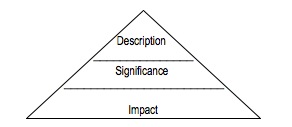
Most candidates have a tendency to focus too much on describing what they’ve done. When you do your write-up, picture e4 as a triangle with three parts: Description, Significance, and Impact. Description is the smallest section because it is the least important. You should therefore use the least amount of space. Be clear and concise–tell what you did in a few short sentences. The details you feel like you have to include will become evident as you go on to explain the significance and impact, so you don’t need to chronicle everything in the first part.
The second part is Significance, which tells why what you’ve described is important (in relation to your work as a learner/leader/collaborator and as a partner with students’ families/community). This section is a bit longer than the Description and can be used as the lead-in to the SI you describe in the third and most important section, which is student impact.
How to keep your write-up focused on student impact
Because the most important part of your accomplishments is the impact on students, you should elaborate on this section the most. While the rubrics don’t require the SI to be specific in every case, the more detailed your examples, the stronger the entry. Your SI could be described using individual student examples, small or whole group achievements , or the impact on your entire grade level/ school/district/state, depending on the type of accomplishment. Be as specific as possible–phrases like “the class did better”, “she liked reading more”, or ‘I really felt like the kids learned a lot” are too ambiguous. If you have trouble describing the SI, you may not want to include the accomplishment. For the purposes of this entry, what you did is only an accomplishment if you can document SI.
Choosing the strongest accomplishments
Because ultimately we want to further the growth of the whole child, accomplishments that impact students on a socio-emotional level or contribute to the functionality of the family unit are certainly worthy of inclusion. However, in my opinion, the majority of your accomplishments should be focused on academic achievement, because our primary goal as teachers is to further students’ cognitive growth. Include the things you’ve done that have had the largest impact on student learning. I would suggest listing possible accomplishments along with ideas for documentation, and then writing about those you think you could provide strong SI for. Afterwards, work with your mentors to choose the strongest accomplishments and get rid of the rest.
Is it better to have more accomplishments?
You can have up to 8. I have seen successful entries that had only 3. This decision is entirely up to you. I do want to clarify that the number of things you’ve done is NOT necessarily the same as the number of accomplishments you write. The portfolio directions clearly state, ‘An accomplishment may be a single activity or event, or a set of related activities and events that are logically related in a unified goal or outcome”. I felt I had accomplished more than 8 things during my career that should be included my entry. I used only 4 accomplishments, but each contained multiple related achievements/events.
For example, one of my accomplishments was about family outreach and communication. I described 4 or 5 different things I did to establish 2-way communication and relevant outreach to family members and included them altogether in one accomplishment. (I wrote the first activity/event’s description, significance, and impact in one paragraph, the second activity/event’s description, significance, and impact in the second paragraph, and so on). Many candidates choose to include related activities in one accomplishment–this is absolutely allowed, and if you’ve done a lot of significant things, I recommend this strategy. However, if you have difficulty coming up with accomplishments, you may want to stick to the one activity per accomplishment formula, and really elaborate on the things you have done.
Do you really have TWO-WAY communication with families?
This is a critical component of e4. You need clear evidence of ongoing, consistent two-way communication. Newsletters and websites are NOT two-way unless you specifically detail how parents use these tools to communicate with you provide and feedback to you.
That’s not to say you should leave those kind of things out of your entry if you use them as only one-way communication tools: they are still significant if you can show SI. You just need to show two-way communication in some other method. Most candidates do this with communication logs, either in the form provided by NB or in one they created. I’m going to debunk a huge myth here- you do not HAVE to use a communication log! If you can show strong evidence of TWO-WAY communication with families without using a log, then consider it optional.
Remember that according to the level 4 rubric, two-way communication should be PRIMARILY focused on academics (‘substantive teaching and learning issues and individual student progress’). A communication log that chronicles phone calls about behavior problems is not as strong as one that also records conversations about academic progress. Assessors are looking not only for frequency in communication, but also variety. Some of the highest-quality communication you can document would include new information you learn about a child (communicated from the parent), followed by changes to your teaching practice you make as a result of that new knowledge (communicated to the parent), and growth on the part of the child as a result (also communicated to the parent).
The purpose of documentation (it’s not just proof that you ‘did it’)
UPDATE MAY 2014: Please see comment section: it appears that assessors are no longer evaluating documentation.
Remember that the purpose of your accomplishments is to show the impact on student learning; therefore, documentation that supports your claims about SI is ideal. The strongest documentation focuses on students’ growth and achievement as the RESULT of the achievement, rather than on proving that you did the accomplishment. This is not always possible, depending on the nature of the accomplishment. However, in general, a verification form from your administrator stating that you ran an after-school tutoring program is not as strong as data showing student growth as a result of that program. The former proves that you did the things you say you did; the later proves the student impact from the things you did, which is what this entry is all about.
Do I have to document everything?
You will need to back up every accomplishment with a documentation of some sort. You do NOT have to document every single thing you say! (This is especially true when you include multiple achievements/events inside a single accomplishment–pick the strongest evidence of SI and include that for your documentation.) However, you DO have to describe everything you document. For example, you cannot write about a workshop you took and then document it with a certificate from another workshop in hopes of getting ‘credit’ from the assessor for both workshops. There must be a tight alignment between your description and your documentation.
Getting the most out of your documentation pages
NB provides a verification form, which in my personal opinion is not usually the strongest evidence of an accomplishment, especially when all the form says is “this person did this thing.” As a candidate myself, I liked to use every inch of space available to me to provide as much evidence and as possible of what I’d done, so most of my documentation pages were collages of different yet related materials.
For example, to document family workshops, I included photos and parent feedback forms on the same page. You are allowed by NB to include multiple items on one page as long as they are related and you do not shrink the text. (I included only small pictures and cut off part of the feedback form, then put it all together on one page and made a photocopy so it looked cleaner).
On another documentation page (for leadership and collaboration), I printed emails (from teachers I helped through this website), cut them out, pasted them onto one page, then photocopied it for a clean look. So, there were multiple emails on one page. I tried to make each page of my documentation different, which is not required, of course, but I think this method provided a more holistic picture of my accomplishments.
Final thoughts
Think creatively, and let your personality and unique interests in particular aspects of your work as teacher show through your entry! Be encouraged- you can do this!!
Angela Watson
Founder and Writer
Discussion
Leave a Reply
OR

Join our
community
of educators
If you are a teacher who is interested in contributing to the Truth for Teachers website, please click here for more information.


Can I used my Sunday school class as an accomplishment, although they are ages 65-92?
Hi, Linda! I haven’t heard of anyone using that as an accomplishment, but that doesn’t mean it can’t be done. You need to be able to show evidence of student impact, and if you can do that, I suppose you could use adult Sunday School teaching experience. Unless you have really spectacular evidence, though, I’d be tempted to leave it out if I were you, and focus on work with kids.
Thanks, Angela.
I do have quite a bit of documentation to show student impact. Also, I teach 10th grade English, but I tutor a first grade student in Language Arts. I use some of the same strategies with her as I do with my 10th grade students. Would you suggest I use this as an accomplishment? I can definitely show student growth. I know I am using different ages to show students impact, but one of my accomplishments will definitely be with my 10th grade students.
Linda
If I were you, I’d write everything up and then delete whatever you see as the weakest evidence of student impact.
Hi thank you for you help. I have done things differently due to covid abs being online. When submitting comp 4 do I focus on what I normally do or what i have done this year? What would you recommned?
I am having trouble with the 2-way communication. I am an exceptional needs teacher and have many emails/phone calls from 2 separate parents and how they appreciate my communication with them both in order better assist their child both in and out of school. I was told by another NBCT that I couldn’t use either of those because I was only doing my job. Any advice?
I do have one entry where I have worked with community partners of my school for tech parent nights and math nights to involve our parental community. It isn’t individual communication, but will that give some demonstration of community communication?
Thank you!!
I think the parent nights are a GREAT way to demonstrate communication! Make sure it’s 2 way communication, though–maybe via a parent survey after the parent nights?
I would not count phone calls and emails to parents as 2 way communication, as it’s not considered going above and beyond the job requirements unless you have a really unique approach.
Thank you so much! I have been very worried about having the BEST evidence of everything for Entry #4. I do have parent and student surveys for my school’s parent night and hopefully I will have some ‘good’ feedback to use as evidence! 🙂
Hi Angela
Thank you for sharing your knowledge about NBPTS. Regarding E4, I just read tonight that “students” can be parents, colleagues or others in the profession. Is it true that SImpact does not have to be actual child but any person whom you are interacting with? I’m thinking of the multiple parent nights I organize throughout the year. Can the parents be the ones impacted as opposed to their students?
Thanks so much!
This was my understanding also, but what would be the purpose of the contextual informtion? I have decided to focus on student inpact, rather than on adults and on younger kids.
Hi, Lisa. I’m not sure I feel qualified to give advice on that. I think you should check with NB or at least with an official NB support group. I would hate to advise you incorrectly. That said, my understanding is that student impact refers to students, though not necessarily your own (hence the work with colleagues and other educators.) My NB certification work was as an early childhood specialist, so all the student impact I tried to show was based on early childhood students (K-3). I would imagine that the purpose of your parent nights was, at some level, to increase student achievement in your class/school, and therefore, I’d try to tie the student impact into that. What did parents do differently after the parent nights that had a positive affect on student achievement? Again, check with someone more official than me on this, but my understanding is that it’s best to keep your student impact focused tightly on your students whenever possible.
Thank you for your replies. I’ll look into calling NB for clarification.
I have accomplishments from workshops I presented at but wonder how do I think this to my students because these workshops were for adult learners (other teachers), any suggestions? If not do you think I should not include this?
Hi, Alisa, the student impact doesn’t have to be YOUR students, necessarily. You can talk about how the strategies you showed the teachers impacted their students. I know that’s difficult to quantify, but try to identify the need (why you spoke about a particular topic) and how helping teachers improve in that area would affect their students’ learning. Presumably the things you showed the teachers are things you’ve tried in your own classroom, so you can speak to how the strategies impacted your students and therefore why you wanted to share those strategies with other teachers. I hope that makes sense. I do think this is something you should ask a mentor in your area or online. I haven’t done any work with NB in 7 years, so I’m pretty rusty on the whole process. This page was written in 2006. 🙂
I found this page today and it has some great examples of how to tie student impact to workshops and parent nights: http://www.mrsruss.com/NBCandidates/nbentry4.html. The tips were mostly learned in the same online NB mentoring group I recommend here: https://truthforteachers.com/free-resources/nbpts/5-best-nbpts-resources.
Thanks again for responding to our questions. Your website has been a “go-to” for me with your other resources as well as the NBPTS information. Thanks for keeping it up to date and checking in.